

Accountability: 15
Should readers hold suffering characters responsible for their bad behavior?

In this column
The complicated victims of The Handmaid’s Tale
Writing the sympathetic villain
Complicating the priest in the prequel
Complicated Victims
I’ve been watching The Handmaid’s Tale.1
Through smart writing, it forces the viewer to answer a tough question: Should I hold suffering people accountable for their bad behavior?
The basics of the novel/series are well known. Because of a fertility crisis, women are subjugated in a dystopian America called Gilead. Some women—the handmaids—are forced to bear children for the elite. What these women endure can be horrifying. There are scenes I’ll never forget.2
Understanding them all as victims, the viewer wants to side with the women of Gilead. But throughout the series, the viewer’s compassion is tested. This is especially true when it comes to the main character June (Offred, Ofjoseph). Some of her behavior is hard to accept. For instance, prior to the oppressive regime’s rise, June knowingly has an affair with a married man. She knew he was married from the start and pursued the relationship nonetheless. She shows no remorse—even after being confronted by the crying wife.
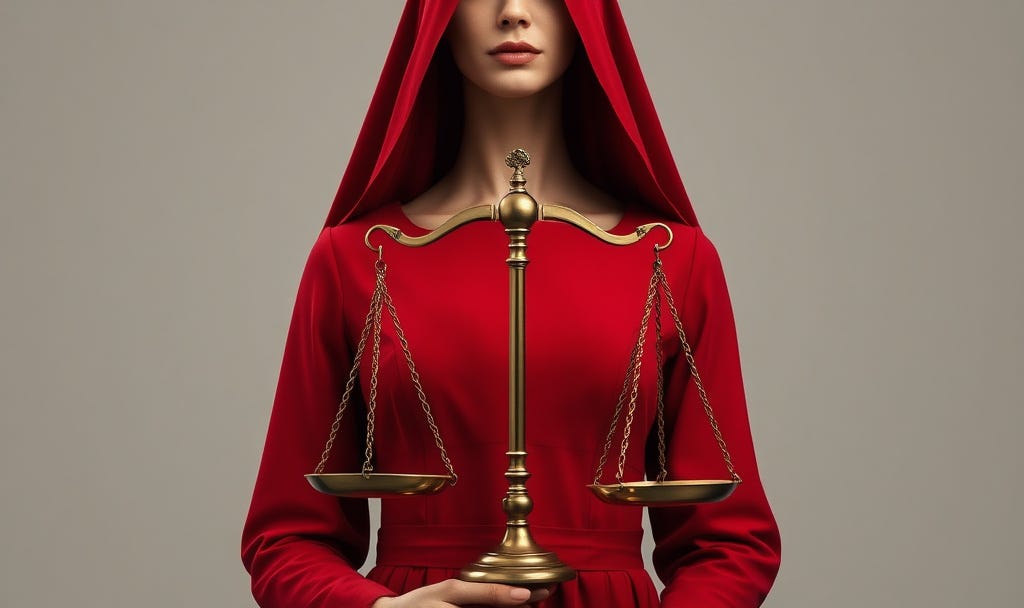
Later June encourages a young, married woman to “grab love wherever you can find it,” blessing that young woman’s pursuit of an extramarital affair. But June knows what will happen to the young woman if she’s caught cheating. June encourages the affair anyway. The young woman is caught, and she is executed.
Later, June tries to enlist another woman in a plot to kidnap a child. The woman doesn’t want to get involved. June pushes. The woman says it will endanger the child. June keeps pushing. June knows what will happen to that woman if she’s caught. But June keeps pressuring her. That woman relents, she is caught, and that woman is executed.
Another character, Serena, helped created the dystopian nation that mistreats women. When in power, she mistreats the powerless women in her household. But then when she has a finger cut off for breaking a law of the very regime she help found, she expects sympathy.
All of these instances ask the viewer: “Does your compassion for this character’s plight override your disdain for that character’s bad behavior?”
In other words, are you willing to still hold that character accountable?
Sympathetic Villain
As a writer, it is tough to walk this line—generating sympathy for a character while demonstrating that this character sometimes isn’t deserving of much sympathy. But I also think it’s necessary. A character who’s 100% innocent-victim isn’t all that interesting. The troubling victim is interesting.
That’s how I conceived of the narrator in COMMUNITY DAY. But rather than starting with “victim” and slowly adding “troubling,” I started with “troubling” and slowly added “victim.”
For most of the early novel, we have little reason to feel badly for him. But Chapter 15 begins the shift from troubling to victim. It’s the first time that the second voice—the doctor—begins to reveal the narrator’s lifetime of struggles.
Rather than describing him as “the accused,” she refers to him as “the patient.” Rather than talking about his prison, she says, “Mercy was the nearest medical setting certified for inpatient services.” Rather than discussing the crimes of which he is accused, she says he demonstrated “symptoms consistent with psychosis, including mania, delusions, and perhaps hallucinations.”
Then, setting up the big theme of the rest of the story, she explains that conditions during the pandemic may be the real culprit. The narrator, she explains, believes “the entire world has gone insane and he is the only one able to understand that.” The reason he wants to talk at length about the causes of Community Day, is that “he is convinced that he has something important to say” about how decades of economic and social struggles, punctuated by Covid, tore his county apart.
My goal was to have the reader constantly wonder if the narrator is a victim deserving criticism or a villain deserving sympathy.

The Prequel
The primary victim of the prequel is likely to be a priest who is widely ridiculed (or detested). I will explain early why people dislike, but eventually it will be clear that he is a godly man deserving better.
My challenge is making this priest complex enough to be compelling. If he’s just a pure man wrongly accused, he runs the risk of being one-dimensional—more of a symbol than an authentic, complicated human. So I’m looking for ways to show his downsides or weaknesses once he is revealed as a wrongly accused victim.
I don’t need to go as far as The Handmaid’s Tale and have my victim responsible for other characters’ executions. But I do want to make him imperfect.

For previous installments of this explanation-and-exploration series:
Chapter 1: Introducing Key Characters
Chapter 2: Forest and Breadcrumbs
Chapter 4: Heisting from Hamlet
Chapter 6: The Mysterious Stranger
Chapter 10: The Madness of Covid
I recently watched Yellowstone, Landman, and Tulsa King, so some counter-programming seemed appropriate