

Politics: Chapter 14
It's the stuff underneath of politics that's most interesting

In this column
Chapter 14 removed from behind the paywall!
Keeping art and politics apart
The politics of COVID school closures
Good Fences
I do government stuff for a living. That’s plenty. I don’t like politics in my movies, music, or novels.
It’s not just that I think that screenwriters, directors, musicians, and novelists have terrible political views and are lousy at talking about political issues—though that’s certainly part of it.
It’s mostly that I think there are much more interesting things to write about.
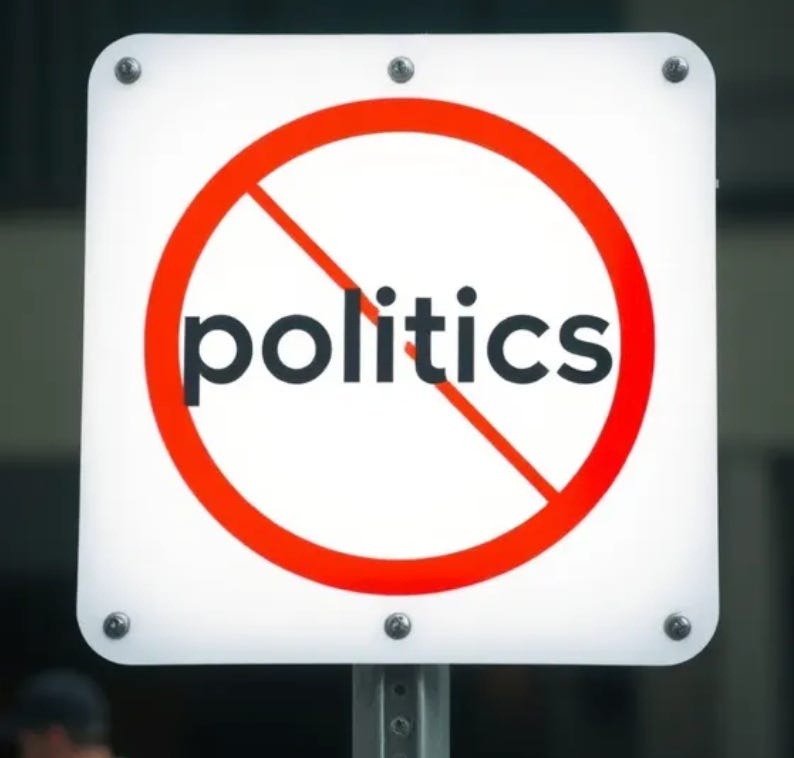
No Politics Allowed
I’m committed to keeping politics out of my own fiction-writing. For example, COMMUNITY DAY primarily takes place during 2020-2021, and it deals with the pandemic and its fallout. But the novel never uses the words “Trump,” “Biden,” “Republican,” “Democrat,” “conservative,” “liberal,” or anything similar.
There’s a governor, but we never learn anything about her party registration or her political views. Same for the narrator’s bete noir—the county executive. We learn nothing about his politics. Same for the HOA president who desperately wants to be in the state legislature. Same for the narrator himself—we learn that he was a high-ranking state official, but we know nothing about his political views.
As I think about writing the prequel, this commitment will be put to the test. It’s going to be set in a state capital, and all of the main characters are going to be in or around the state government. More on that below.
But I do make one near exception to the no-political-stuff rule in COMMUNITY DAY. And it takes place in Chapter 14.
The School-Closure Exception
I don’t think it’s much of a sacrifice to avoid politics in fiction-writing because the most interesting aspects of politics are just the result of human nature. Ambition, selfishness, lust for power, devotion, revenge, survival, sacrifice. You can write about those themes without embedding them in political figures or events.
In COMMUNITY DAY, I knew I wanted to write about the closure of schools during the pandemic. The evidence now shows convincingly what many of us intuited at the time—that it was a dreadful decision it was to shutter schools for so long.
I wanted to get across the idea that closures were gambling with kids’ futures. I also wanted to suggest the selfishness of those who were pushing for long closures.
So Chapter 14—ironically titled “Service”—is built around a single scene: the executive committee of the local teachers union is holding an emergency meeting at a casino. It’s a very short chapter, and I wrote it so it could stand alone—you can get the point of the chapter even if you haven’t read the rest of the novel.
So I’m removing Chapter 14 from behind the paywall. You can read it for yourself here.
Here’s a taste:
As we made room around the table, the leader introduced himself to me with a handshake. His grip was light, his skin soft. “I’m the skipper of this crew,” he swaggered. He exuded leadership with his yellowed Bernie Sanders campaign t-shirt and jean shorts. “Name’s Michael Powers—that’s my nom de guerre—but comrades call me ‘Mikey P’.” He explained that he’d taught English composition and life skills at the local high school for 30 years “before getting bumped upstairs to lead the workers’ struggle.”
The Prequel
So how in the world do I keep politics out of the prequel if the setting, characters, and plot are wrapped up in government stuff?
Two things are going to help me. The first is the timing. It will be set in the early 1990s—the bygone and lower-voltage era of George HW Bush and Bill Clinton. Few contemporary readers will be thirsting for an exploration of that era’s long-forgotten politics.
Second, all of the big storylines will be about things easily disconnected from politics: The love between the two main characters, the brutal ambition of the villain, the selflessness of a mother and a daughter, the moral courage of a priest. As in COMMUNITY DAY, my intention is to never mention political parties or ideology.
In my mind it will be a political novel without any politics.

For previous installments of this explanation-and-exploration series:
Chapter 1: Introducing Key Characters
Chapter 2: Forest and Breadcrumbs
Chapter 4: Heisting from Hamlet
Chapter 6: The Mysterious Stranger